California Grey Whale


CLICK HERE TO CLAIM OFFER
Buy tickets online or call (949) 675-0551 to schedule a cruise
- California Grey Whale Description - Physical description of the California Grey Whale - Attributes and characteristics
- Whale Watching California - Route of the California Gray Whale migration and where to see them
- What California Gray Whales Eat - Diet and consumption of the California Grey Whale
- Whale Watching California Migration - Detailed path of migration and time frame of the California Gray Whale
- California Grey Whale Conservation - Environmental impact of the California Grey Whale
- History of Whale Watching In California - How whale watching began in California
- California Grey Whale naturalists on board - Experts on the California Gray Whale and education will accompany your trip
- Choosing a California Whale Watching Trip - Why to choose California for your whale watching destination
- What You Won't See when California whale watching - What to look for and what not to look for on your whale watching trip in California
- What To Wear Whale Watching - Details on what to wear in sunny California for your whale watching tour
- What To Bring When Whale Watching In California - Items you would like to have during your whale watching trip
- Concerns of motion sickness when whale watching off of California - Precautions and preventions
- Children and California whale watching - Answers to parents questions about kids and whale watching
- Whale Watching Precautions To Ensure California Grey Whales Are Not Disrupted - Rules and Laws that we follow to protect the whales
- Whale Watching California and Whale Watching on the Pacific Ocean - What whales are found off the Coast of California
- California's Whaling and Whale Watching History - Why California chooses whale watching instead of whaling
- Locations For Whale Watching In California
California Grey Whale Physical Description
The California Gray Whale or California Grey Whale (Eschrichtius robustus) is a whale that travels between feeding and breeding grounds yearly. It reaches a length of about 16 meters or 52 ft, a weight of 36 tons or 80,640 pounds (wow) and an age of 50-60 years. Gray Whales were once called Devil Fish because of their fighting behavior when hunted. The Gray Whale is the sole species in the genus Eschrichtius, which in turn is the sole genus in the family Eschrichtiidae. This animal is one of the oldest species of mammals, having been on Earth for about 30 million years. In the remote past it was preyed upon by Megalodon sharks (which are now extinct).
 Gray Whales are distributed in a North-eastern Pacific (American) population and critically endangered North-western Pacific (Asian) population. A third population in the North Atlantic became extinct in the 17th century. The Gray Whale has been traditionally placed in its own monotypic genus and family, however recent DNA sequencing analysis indicates that Gray Whales are more closely related to the Humpback (Megaptera) and the Blue Whale than to the remaining rorquals of Balaenoptera. Though two populations, a north-west Pacific or Asian and north-east Pacific or American, are recognized, they are not deemed distinct enough to warrant sub specific status.
It was first described from remains found in England and Sweden, where it had become extinct long before. Initially named Balaenoptera robusta by Wilhelm Lillebjorg, it was placed in its own genus by John Gray, naming it in honor of zoologist Daniel Eschricht. Meanwhile the living Pacific species was described by Cope as Ranchianectes glaucus in 1869. Skeletal comparisons showed the Pacific species to be identical to the Atlantic remains in the 1930s and Gray's name has been generally accepted since.
The name Eschrichtius gibbosus is sometimes seen; this is dependent on the acceptance of a 1777 description by Erxleben. Many other names have been ascribed to the Gray Whale, including Devil Fish, Gray Back, Mussel Digger and Rip Sack.
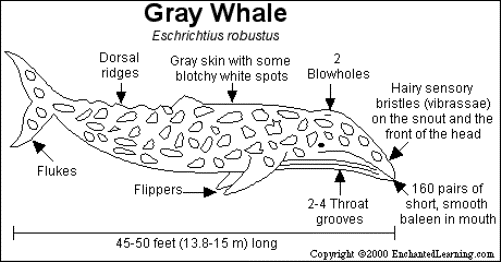
Gray Whales are a dark slate-gray in color and covered by characteristic gray-white patterns, scars left by parasites which drop off in the cold feeding grounds. They lack the numerous prominent furrows of the related rorquals, instead bearing two to five shallow furrows on the underside of the throat. The Gray Whale lacks a dorsal fin, instead bearing several dorsal 'knuckles' lozer.
» Back to top
California Grey Whale & Whale Watching In California
 In the fall, the Eastern Pacific, or California, Gray
Whale starts a 2-3 month, 8,000-11,000 km (or 6,835 miles) trip south
along the west coast of Canada, the United States and Mexico. The animals
travel in small groups.
The destinations of the whales are the coastal
waters of Baja California and the southern Gulf of California, where they
breed and the young are born. The breeding behavior is complex and often
involves three or more animals. The gestation period is about one year,
and females have calves every other year. The calf is born tail first
and measures about 4 meters in length. It is believed that the shallow
waters in the lagoons there protect the newborn from sharks.
In the fall, the Eastern Pacific, or California, Gray
Whale starts a 2-3 month, 8,000-11,000 km (or 6,835 miles) trip south
along the west coast of Canada, the United States and Mexico. The animals
travel in small groups.
The destinations of the whales are the coastal
waters of Baja California and the southern Gulf of California, where they
breed and the young are born. The breeding behavior is complex and often
involves three or more animals. The gestation period is about one year,
and females have calves every other year. The calf is born tail first
and measures about 4 meters in length. It is believed that the shallow
waters in the lagoons there protect the newborn from sharks.
After several weeks, the return trip starts. This round
trip of 16,000-22,000 km (or 13,670 miles), at an average speed of 10
km/h, is believed to be the longest yearly migration of any mammal. A
whale watching industry provides ecotourists and marine mammal enthusiasts
the opportunity to see groups of Gray Whales as they pass by on their
migration.
» Back to top
California Gray Whales Can Eat!
The whale feeds mainly on benthic crustaceans which it eats by turning on its side (usually the right) and scooping up the sediments from the sea floor. It is classified as a baleen whale and has a baleen, or whalebone, which acts like a sieve to capture small sea animals including amphipods taken in along with sand, water and other material. Mostly, the animal feeds in the northern waters during the summer; and opportunistically feeds during its migration trip, depending primarily on its extensive fat reserves.
» Back to top
California Grey Whale Migration
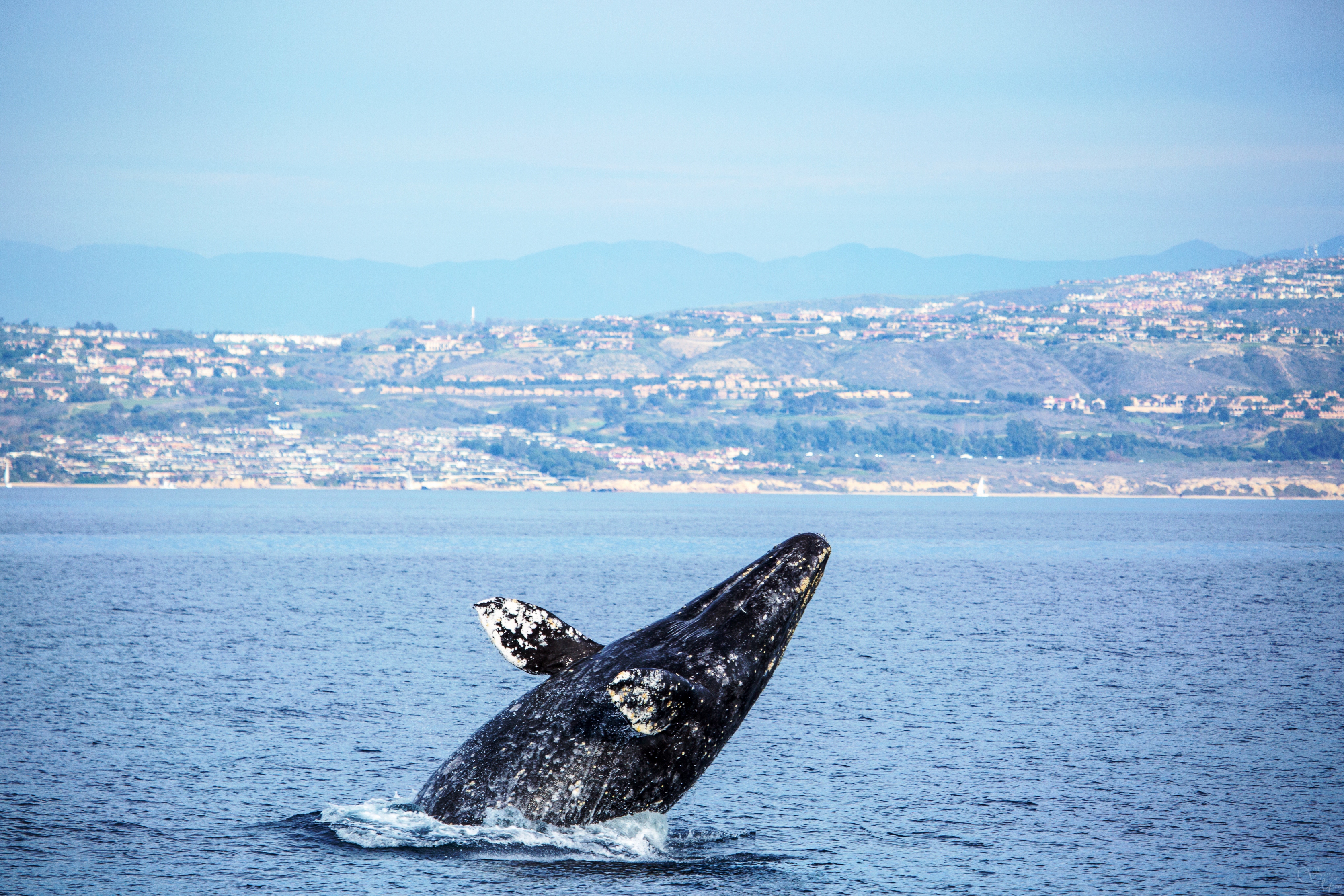 The migration route of the Eastern Pacific, or California, Gray Whale is often described as the longest known mammal migration. Beginning in the Bering Sea and ending in the warm-water lagoons of the Baja peninsula, their round trip journey moves them through 12,500 miles of coastline.
This journey begins each October as the northern ice pushes southward. Traveling both night and day, Gray whales average approximately 120 km (80 miles) per day. By mid-December to early January, the majority of the Gray whales are usually found between Monterey and San Diego, where they are often seen on Newport Landing Whale Watching cruises.
By late December to early January, the first of the Gray Whales begin to arrive the calving lagoons of Baja. These first whales to arrive are usually pregnant mothers that look for the protection of the lagoons to give birth to their calves, along with single females seeking out male companions in order to mate.
The three primary lagoons that the whales seek in Baja California are Scamnon's (named after a notorious whale hunter in the 1850's who discovered the lagoons and later became one of the first protectors of the Greys), San Ignacio and Magdalena. As noted, the California Grey Whales were called the devil fish until the early 1970's when a fisherman in the Laguna San Ignacio named Pachico Mayoral (although terrified to death) reached out and touched a Grey mother that kept approaching his boat. Today the whales in Laguna San Ignacio are protected but it is possible to visit a whale camp there and have the same experience that Pachico had.
Throughout February and March, the first Gray Whales to leave the lagoons are the males and single females. Once they have mated, they will begin the trek back north to their summer feeding grounds in the Bering seas. Pregnant females and nursing mothers with their newborn calves are the last to leave the lagoons. They leave only when their calves are ready for the journey, which is usually from late March to mid-April.
» Back to top
California Grey Whale Conservation
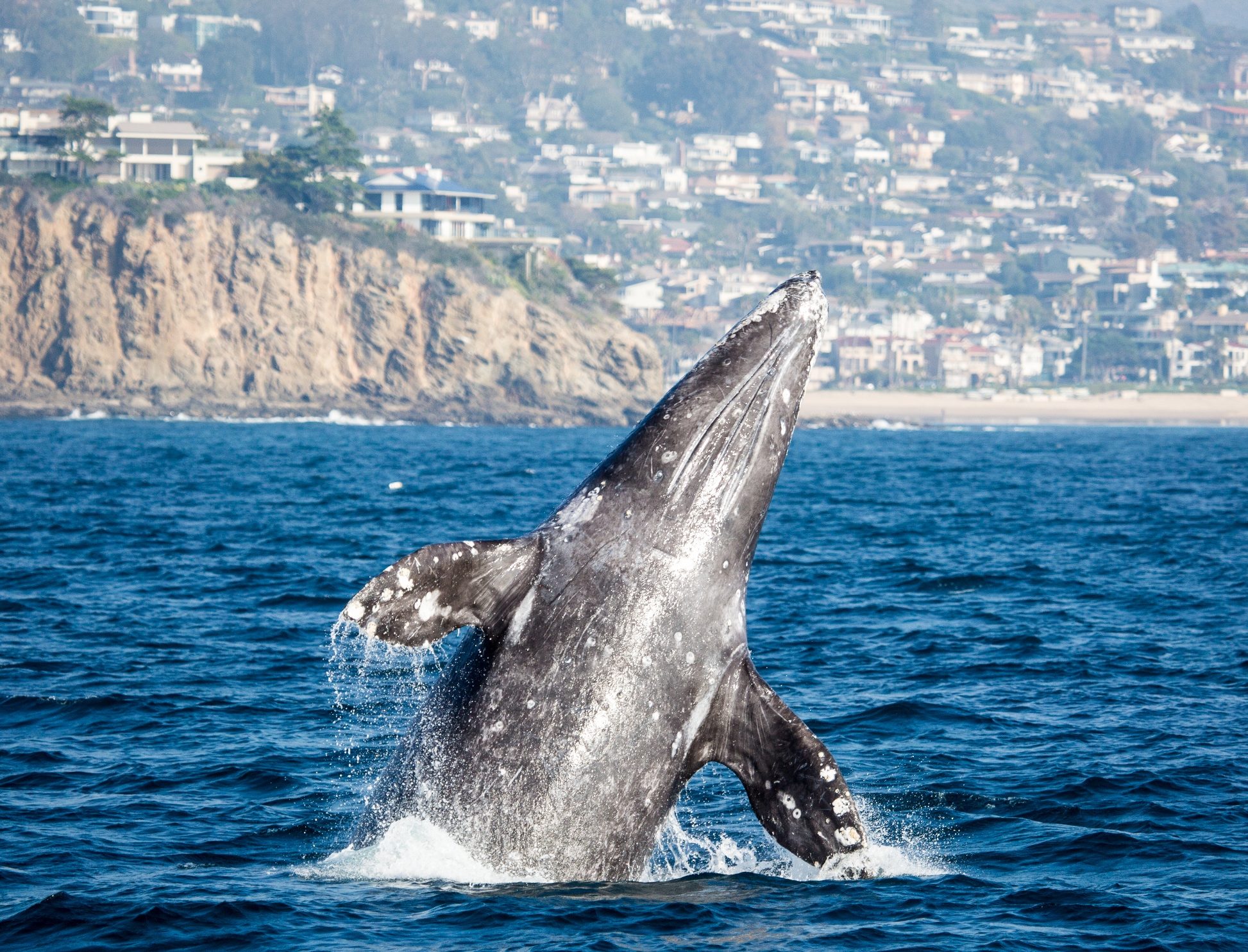 The only predators of adult Gray Whales are humans and Orcas. After the California Gray Whales' breeding grounds were discovered in 1857, the animals were hunted to near extinction there. After harvesting became inefficient because of dwindling numbers, the population recovered slowly, but with the advent of factory ships in the 20th century, the numbers declined again. Gray Whales have been granted protection from commercial hunting by the International Whaling Commission (IWC) since 1949, and are no longer hunted on a large scale.
Limited hunting of Gray Whales has continued since that time, however, primarily in the Chukotka region of north-eastern Russia, where large numbers of Gray Whales spend the summer months. This hunt has been allowed under an "aboriginal/subsistence whaling" exception to the commercial-hunting ban.
Currently, the annual quota for the Gray Whale catch in the region is 140 whales per year. A smaller quota of 4 whales per year was established for the Makah Indian tribe of Washington at the IWC's 1997 meeting, but with the exception of a single Gray Whale killed in 1999, the Makah people have been prevented from conducting Gray Whale hunts by a series of legal challenges, culminating in a United States federal appeals court decision in December 2002 that said the National Marine Fisheries Service must prepare an Environmental Impact Statement before allowing the hunt to go forward. On September 8, 2007, five members of the Makah tribe shot a gray whale using high powered rifles in spite of the limitations. The whale died within 12 hours, sinking while heading out to sea.
As of 2001, the population of California Gray Whales had grown to 26,000.
» Back to top
The History of Whale Watching in California and Throughout the World
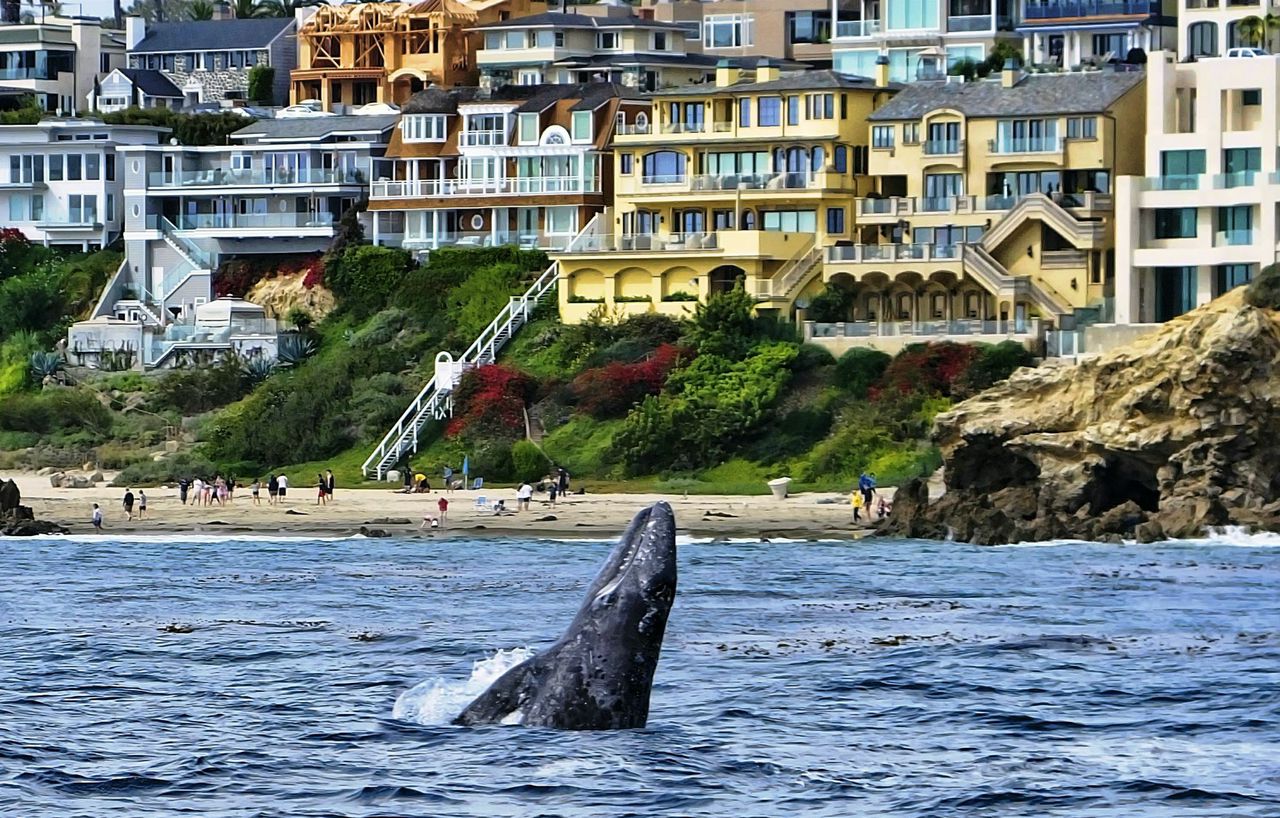 Whale watching is the practice of observing whales and other cetaceans in their natural habitat. Whales are watched most commonly for recreation, but the activity can also be for scientific or educational reasons. Whale watching as an organized activity dates back to 1950 when the Cabrillo National Monument in San Diego was declared a public spot for the observation of Gray Whales. In 1955 the first water-based whale watching commenced in the same area, charging customers $1 per trip to view the whales at closer quarters. The spectacle proved popular, attracting 10,000 visitors in its first year and many more in subsequent years. California whale watching was the birthplace for whale watching throughout the globe.
In 1971 the Montreal Zoological Society commenced the first commercial whale watching activity on the eastern side of North America, offering trips in the St. Lawrence River to view Fin and Beluga Whales.
In the late 1970s the industry mushroomed in size thanks to operations in New England. By 1985 more visitors watched whales from New England than California. The rapid growth in this area has been attributed to the relatively dense population of Humpback Whales, whose acrobatic behavior such as breaching (jumping out of the water) and tail-slapping was an obvious crowd-pleaser, and the close proximity of whale populations to the large cities on the east coast of the US.
Throughout the 1980's and 1990's whale watching spread throughout the world. In 1998 Erich Hoyt carried out the largest systematic study of whale watching yet undertaken and concluded that whale watching trips were now available in 87 countries around the world, with over 9 million participants generating an income to whale watcher operators and supporting infrastructure (such as accommodation, restaurants and souvenirs) of over one billion dollars. His estimate for 2000 was for 11.3m participants spending $1.475bn, representing a five-fold increase over the decade.
Whale watching is of particular importance to developing countries as coastal communities start to profit directly from the whales' presence, significantly adding to popular support for the full protection of these animals from any resumption of commercial whaling.
Whale watching today is carried out from the water via crafts that range from kayaks, motorized rafts, and sailboats to former fishing or whaling boats as well as custom-built craft carrying as many as 400 people. Whale watch trips may last one hour, two hours, half a day, a full day, two or three days, or on up to ten or fourteen days. You may spend as little as $22 or $25 per person for a 2 hour-long trip or more than $3,000 for a two-week expedition with several stops.
» Back to top
Naturalists on Board
Some trips are strictly for pleasure, some are research oriented, and some successfully combine both elements. Many whale-watch tours are family-run businesses; some are sponsored by scientific institutions and research organizations. Our California whale watching cruises combine both elements this makes each cruise an exciting and informative experience. A word is in order about the nature of "naturalists" on board. The term generally refers to the person or persons who narrate the whale watch trips, providing educational information about the California Grey whales, their behaviors and habitat, and about the other creatures that share the marine environment. Some naturalists are marine biologists or oceanographers. Some are affiliated with, and trained by, research organizations and scientific institutions. On some trips, narration is provided by knowledgeable captains, people who have been going to sea with whales for years and have made a point of educating themselves so they can answer passengers' questions correctly. On some trips where no narration is provided, tour operators show an educational video on whales and hand out written materials provided by whale conservation organizations. Probably it is unwise to judge a trip's worth based solely on whether or not a naturalist is on board. Booking passage on a whale watching trip, with or without a naturalist, is no reason not to educate yourself before you get on the boat. Many wonderful books about whales and whale biology are in print, available at libraries and bookstores all over the country.
» Back to top
Choosing a Trip
Newport Landing's California whale watching tour boats stay in constant radio contact with one another in case one sights whales that others have overlooked. Our California whale watching tour operators are infused with enthusiasm for the sport and are proud to be sharing the experience with their passengers. Seek out those whale watching tour operators who "guarantee" that you'll see a whale or they'll give you a free trip not an uncommon offer in those areas where whales are practically willing to keep appointments with tour operators, year after year. And if you can afford it and you're so inclined, sign up for more than one trip. Because of the nature of the beast, every trip is unique.
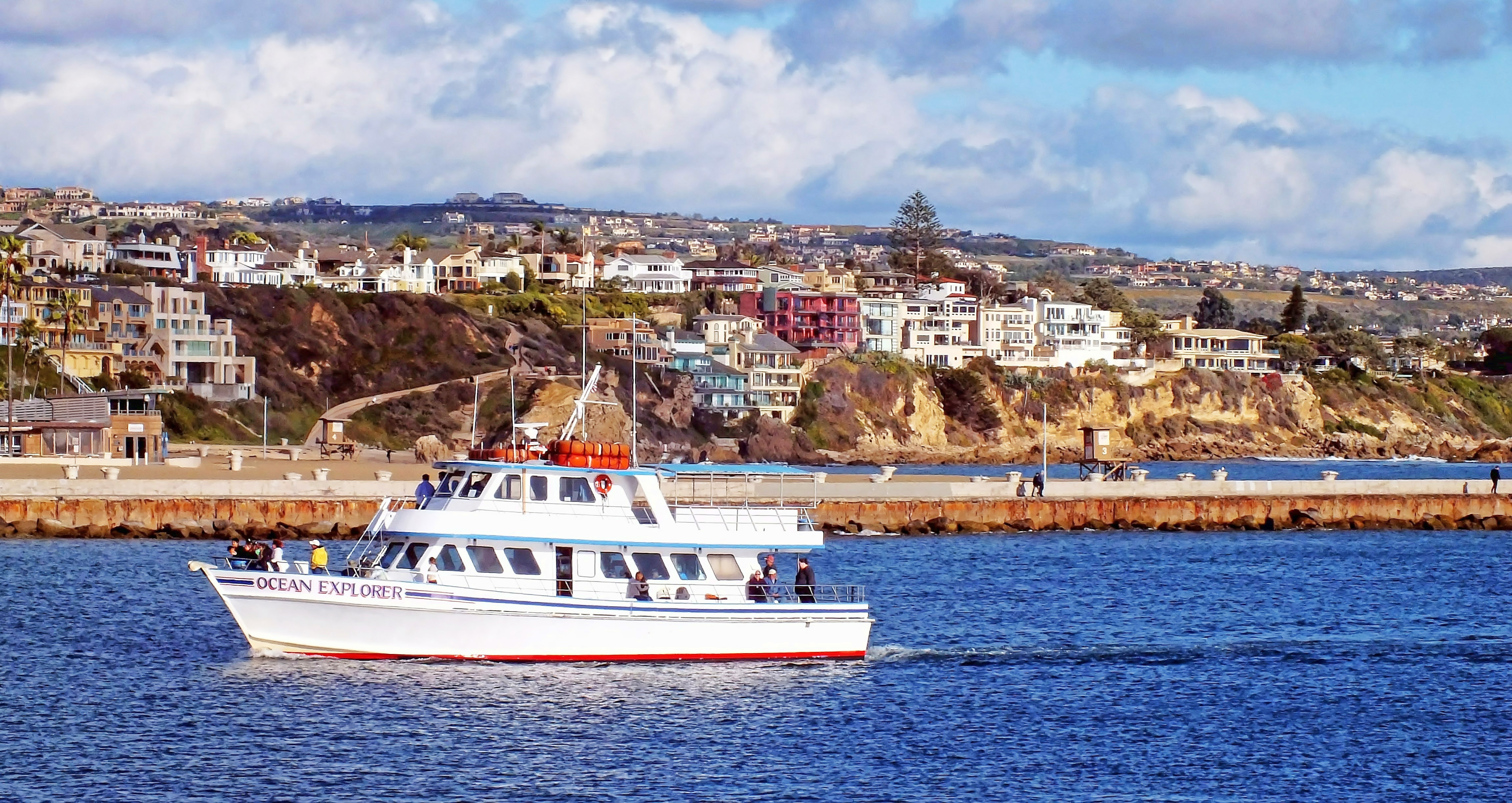 Before you can do any California whale watching, you will likely have to do some whale waiting. While you're waiting, watch the water's surface for flying fish, other marine mammals, or even shark fins. Confronted with a vast expanse of ocean, many people initially think that "there's nothing out there." But that's just not true. Everything is out there. A whole world is just beneath the water's surface, and if you watch carefully, you will see evidence of that world. Also, look up and meet assorted seabirds that you're not likely to see flying over landlocked cities.
En route to where whales are supposed to be, you can always scan the horizon, just in case a whale might have meandered into new territory. California Grey Whales are blissfully ignorant of our schedules and calendars and maps, and they often pop up when and where we least expect them.
Keep your eyes open and watch for that first thrilling sight of a California Grey whale spout against the horizon. One naturalist once described it as similar to a car radiator "blowing off steam"; after the steam subsides, look for a glimpse of what appears to be a shiny black stretch limo.
» Back to top
What You Won't See
What you can't expect is to see California Grey whales where you want them to be exactly when you want them to be there. This is nature, real life; not a multimillion-dollar theme park where every surprise is scheduled. Patience must rule the day. When you do see whales, you will realize they were worth the wait. Also, you will return to shore exhilarated, better educated about a fascinating animal, and more aware of what's at stake if we lose even one species to extinction.
Sometimes people are disappointed when they first see a whale spout. "That's it?" they say. "That little puff of steam that the wind blew away?" But when you've had a chance to do some California whale watching, you will find out that each of the great whales has a distinctive spout. Literally a large roomful of air and mist is exhaled each time a whale breathes. If you're familiar with the height and shape of the different blows, and if the wind isn't too strong, and if you're facing the whale head on, sometimes you can tell exactly what sort of whale you're seeing even if you don't get a glimpse of the body or the dorsal fin or some other telltale sign. And sometimes, of course, you can't.
If you know what to expect, if you know that the great whales range in size from 45 to 90 or 100 feet and weigh as much as 1.5 tons per foot, you're less likely to be disappointed at the sight of a spout. If you know that a blue whale can weigh as much as thirty-two elephants or that a toddler could crawl through the arteries of any full-grown great whale or that a humpback's flipper is more than twice the height of the tallest person you know, then your sense of excitement about even a distant sighting will increase. Chances are good - guaranteed at some spots such as Newport Harbor during December thru April for California Grey Whales - that you will see much more than a spout. Take binoculars or rent them from Newport Landing, to get a closer look at whales in the distance.
» Back to top
What To Wear When Whale Watching In California
Of course, no matter how close California Gray whales come to the boat, you can't watch them comfortably if you're not dressed appropriately. No matter how sunny and warm it is in town or even at the dock, once you're out on the water the temperature may be somewhat cooler. If the wind is blowing, it may be a little cooler yet.
When you pack a backpack or tote for whale watching, put in the obligatory sunscreen, a hat or visor, a sweatshirt or sweater, and a jacket. Wear sunglasses, long pants or jeans, a comfortable shirt, socks, and comfortable shoes.
» Back to top
What to Bring when Whale Watching in California
 A camera is the obvious answer and this from a person who has an album full of fuzzy, out-of-focus pictures of whales and pictures of where whales just were. Unless you are a professional nature photographer accustomed to shooting from boats rocking gently (and not so) on the sea, you probably won't get professional-quality nature photos. However, you probably will get perfectly acceptable snapshots of tail flukes, dorsal fins, a flipper or two, and maybe even a whole California Grey whale at midbreach. And so you should bring your camera.
That said, it is also true that documenting whale behavior through a camera lens is not nearly as exciting as taking in the experience with all your senses turned up high. At some point, put down the camera and bring your mind's eye into sharp focus. Stare hard at the creature, noting the texture and color of its skin, any scars or scratches, the flash of baleen when it opens its mouth, the way the water streams down the ventral pleats under the whale's chin, or the places where barnacles are gathered. Listen to that most amazing sound when the whale breathes. . Inhale deeply of the fresh air and taste the salt on your lips. Memorize the moment with your every pore, and it won't matter whether or not the photographs turn out.
» Back to top
Concerns of Motion Sickness
California whale-watching trips are suitable for almost everyone, from the exceptionally sea hardy to those who rely on pills or patches to stave off the possibility of motion sickness. Trips to the Farallon Islands off San Francisco are particularly rigorous; the outings within the confines of the southern California coastline are remarkably calm. Just a reminder for motion sickness pills to be the most effective, you must take them at least thirty minutes before you board the boat. Dramamine makes most people sleepy; Bonine makes only some people sleepy. Both are available at Newport Landing office.
Medicated patches, worn behind the ear, are generally effective but can sometimes cause a reaction. Ginger has a reputation for preventing motion sickness, and is available in capsule form at most health food stores. On a positive note, even the queasiest passengers feel better when the whales show up. Of course, many people who take no precautions at all do not become seasick. Please don't stay home because you are worried that you might get sick -- after all, you might not. If you do start to feel uncomfortable, stay outside in the open air, keep your eyes on the horizon, and breathe deeply. Nibble on plain soda crackers; sip ginger ale. Stave off panic by thinking about anything except being sick.
» Back to top
Children
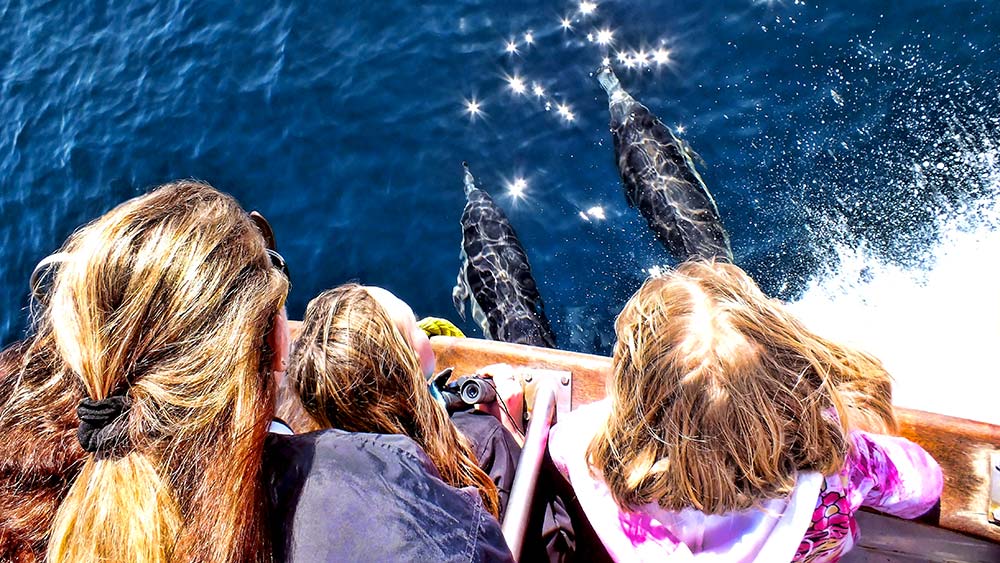 Those children under age five may not enjoy being confined on a boat for an extended period of time. As for older children a whale watching cruise offers constant new and unique experiences from traveling the harbor and sampling the nautical venue to viewing the many unique and diverse marine creatures. Entertainment and education make California whale watching an ideal activity for kids of all ages. Discussions about what to expect prior to departing or after the whale watching tour can add even more to the California whale watching experience.
» Back to top
Whale Watching Precautions To Ensure California Grey Whales Are Not Disrupted
Environmental campaigners, concerned by what they consider the "quick-buck" mentality of some boat owners, continue to strongly urge all whale watcher operators to contribute to local regulations governing whale watching (no international standard set of regulations exist because of the huge variety of species and populations). Common rules Newport Landing practices include:
- Minimize speed / "No wake" speed
- Avoid sudden turns
- Minimize noise
- Do not pursue, encircle or come in between whales
- Approach animals from angles where they won't be taken by surprise
- Consider cumulative impact - minimize number of boats at any one time/per day
- Do not coerce dolphins into bow-riding
» Back to top
Locations for Whale Watching in California
San Francisco California
http://www.riptide.net/whale.htm
Monterey California
http://www.montereybaywhalecruise.com
Newport Beach California
https://www.newportwhales.com
http://www.daveyslocker.com
San Diego
http://www.hornblower.com
Pacific Ocean
On the West Coast of the United States and Canada, excellent whale watching can be found in Alaska (summer), British Columbia, and the San Juan Islands/Puget Sound in Washington, where pods of orca are even sometimes visible from shore. The usual suspects including humpbacks, California grey whales, and blue whales. The west coast of Mexico including Baja California is an area known for its grey whale calving as well, and tourists flock here to witness mothers with their very large and inquisitive babies.
» Back to top
Whaling and Whale Watching (We Vote Whale Watching!)
All three of the current major whaling nations (Norway, Japan and Iceland) have large and growing whale watching industries. Indeed Iceland had the fastest-growing whale watching industry in the world between 1994 and 1998.
Many conservationists now espouse the economic argument that a whale is worth more alive and watched than dead in order to try to persuade the governments of whaling nations to curtail whaling activities. The correctness of this argument is the subject of much debate at the International Whaling Commission; particularly since argue about the whaling countries the 'scarcity' of whale meat which supposedly has caused it to become a luxury item, increasing its value. However, whale meat markets have collapsed and in Japan the government keeps its flow artificially through subsidies and whale meat distribution in schools and other forms of whale meat promotion. In 1997 2,000 tons of whale meat was sold for $30m - a single 10 tonne Minke Whale would thus have been worth $150,000. There is no agreement as to how to value a single animal to the whale watching industry, though it is probably much higher. It is possible to construct arguments that 'prove' a single whale is worth either much more or much less than this figure. However, it is clear from most coastal communities that are involved in whale watching that profits can be made and are more horizontally distributed throughout the community than if the animals were killed by a whaling industry.
Upon the resumption of whaling in Iceland in August 2003, pro-whaling groups, such as fishermen who argue that increased stocks of whales are depleting fish populations, suggested that sustainable whaling and whale watching could live side-by-side. Whale watching lobbyists, such as Husavik Whale Museum curator Asbjorn Bjorgvinsson, counter that the most inquisitive whales, which approach boats very closely and provide much of the entertainment on whale-watching trips, will be the first to be killed by whalers. Pro-whaling organizations such as the High North Alliance on the other hand, have said that whale watching is not profitable and that some whale-watching companies in Iceland are surviving only because they receive funding from anti-whaling organizations.
» Back to top
Reserve your whale-watching trip!
Newport Whales runs whale watching excursions multiple times a day seven days a week all year long. Along with viewing Whales you can expect to see dolphins, sea lions, marine birds, and other neat marine creatures. Please try to arrive at least 30 minutes before your cruise departure time. Need help with directions or parking or for making reservations on cruises less than 24 hours away, please give us a call (949) 675-0551.
BOOK ONLINE BELOW FOR $22 SPECIAL OR
CALL (949) 675-0551 AND MENTION PROMO: CAL22
SHARE
FOR RESERVATIONS, CALL (949) 675-0551